This is just east of Park Avenue at 125th street. The structure in the center of the picture was once Harlem Hall. The photo is dated 1904 and the Harlem Hall now houses the Majestic Hall as well as a theater calling itself The Orpheum. It is referred to as a Loew's theater. The only Loew's Orpheum I could find is, the one we all new and loved as kids, on 86th Street between Lexington and Third. That theater, designed by none other than Thomas Lamb, opened in 1913.
This is 125th street on the west side Park Avenue, we are facing towards the east. The loss of the building on the corner is up there with the destruction of the old Pennsylvania Station, the Riverside, Riviera and Roxy theaters and the old Federal Hall (well, in 1842 no one thought about historic preservation). This the 1883 Mount Morris Bank Building. This was the only branch and the headquarters for this bank. Eventually the Corn Exchange Bank, a fore - runner of Chemical Bank, took it over. The major historical event that took place in this bank was when a Corn Exchange teller grew suspicious of a depositor’s $10 gold certificate. It turned out to be part of the ransom paid for Charles Lindbergh’s kidnapped infant son. The certificate was traced to Bruno Hauptmann, who was arrested within the week and eventually executed for the baby’s murder.
The building survived through the 1970's but by the late '70's the building was basically abandoned. The City tried to seal up the building by cinder blocking all the openings on the lower floors. As we all know, that doesn't work. In 1997 a fire took off the top two floors.
This is the building now. More like a nub of a building. I guess cinder block does last. This building, in a much dilapidated state, was landmarked by the City prior to the devastating fire in 1997. Whether the building was abandoned by it's last owner or what, a restoration was not forth coming and the building had to be reduced to the nub it is today for safety reasons. I passed this building recently and it is still a nub, a landmarked nub.
This is the Harlem Casino. Some have said that this is / was the oldest theatrical building left in Manhattan. After that initial laying of the cornerstone on June 11th 1889, everything went wrong for what was going to be the West End Theatre. The theater’s owner and backer ran out of money soon after the cornerstone was laid and the foundation in place.
It turns out that the developer, A.H. Wood, who had built upon his self-perpetuating myth by designating himself “Napoleon” Wood, the theatrical wunderkind, not who he said he was. He was really named Charles Hahr, or Charles Morris, a known forger who had somehow managed to marry into a prominent family. Evidently he was accused of, but never indicted for, poisoning his father-in-law. He had hoped to speed up his inheritance from his wealthy father-in-law. At the time it was also discovered that Charles Hahr/A.H. Wood was the same man police were seeking in a series of unusual cases involving blackmail. Hahr’s practice was to observe trials in process at the police courts and wait for any information one of the parties would not want made public. Then he would visit the party at home, pretending to be a reporter who would expose any tawdry details unless a payment was made. Usually he asked for $100 but was willing to accept whatever he could get. My favorite con he would pull was to pay Harlem children to skip class, then to visit the parents of the children. Pretending to be a truancy officer, he would promise not to bring any charges if they gave him money.
The West End Theatre, meanwhile, stayed unfinished with only the foundation built. Eventually, a two-story market was put on top of it, and then, in the middle 1890s, the Harlem Casino – which became the Loew’s 7th Avenue and, later, the Greater Refuge Temple. So this building at 124th Street and 7th Avenue represents the oldest foundation for a theatrical structure in Manhattan.
Incidentally, in 1902 a theater with the name “West End” was constructed, on 125th Street near St. Nicholas Avenue. That building still exists today.
In 1910, future movie mogul Marcus Loew, who then resided on 111th and Seventh Avenue, acquired the Harlem Casino and converted it into a 1600 seat theatre for vaudeville and movies. All that remained of the old Casino were the exterior walls and the roof. The success of Loew's Seventh Avenue Theatre helped to finance the building of the larger and more sumptuous Loew's Victoria Theatre, which opened nearby on 125th Street in 1917. Loew's Seventh Avenue Theatre continued operating until around 1934, when it fell victim to the Depression.
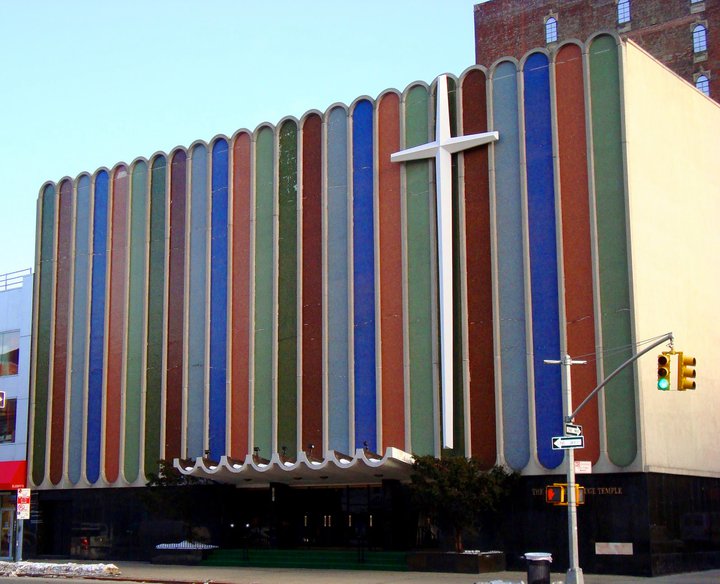
Like many of the Harlem theatres (and Synagogues), it eventually became a church. As the Greater Refuge Temple of Christ it was ultra-modernized both inside and out by architect Costas Machlouzarides in 1966. Pretty trippy.
This is the Harlem Opera House. Opening in 1889 this theater was the work of architect John B. McElfatrick, who designed numerous late-19th century theaters around New York and theater impresario Oscar Hammerstein. Among those who performed on its stage during its early years included Edwin Booth, Lillian Russell and Sophie Tucker. Having been built for legit theater, the house went vaudeville then vaudeville and movies then just movies and finally just bowling.
This is the interior very early in the life of this theater. The location of this theater was just west of 7th Avenue on the north side of 125th Street. The block between 7th and 8th Avenues would, by 1917, be home to three of the biggest and most important theaters in Harlem. Built to hold just over 1500 patrons, the theater used both gas and that new invention electricity for lighting.
Another early interior view. By the turn into the 20th century, the Harlem Opera House was in the hands of Keith - Albee. By 1922 it was taken over by Frank Schiffman and Leo Brecher who eventually took over the Apollo Theater once the owner, Sidney Cohen, passed away. It was Sidney Cohen who saw the future of 125th Street and eliminated segregation policies but it was Schiffman and Brecher who got the world famous Amatuer Nights under way.
This is the marquee of the Harlem Opera House in 1934. The picture playing is a Universal Picture starring Lee Tracy, the actor who originated the role of Hildy in Ben Hecht's The Front Page when it opened on Broadway (Pat O'Brien played the role in the 1931 picture) A more enlightened and racially sensitive policy is shown as the vaudeville attractions cater to the ever increasing African American population of Harlem. It must be summer as it is "cool inside". The following year, 1935, Schiffman and Brecher take over the Apollo and to eliminate competition between the two theaters, vaudeville is eliminated at the Harlem Opera House (the Apollo was larger).
This is the marquee for Loew's Victoria. It was just west of the Harlem Opera House so all the photographer had to do was step back 50 feet. It is still summer, as it did not take that long to move the camera. Also you can tell it is warm given all the short sleeves. The picture playing is from 1934 as well. It is The Witching Hour, a remake of a 1916 picture of the same name. It was made at the very end of the "pre-code" era and was directed by (one of my favorites) Henry Hathaway. Henry Hathaway was one of those directors who (later in his career) liked to shoot on location. He shot some of the 1946 picture Dark Corner (starring Lucille Ball and Mark Stevens) here in New York. In 1945 he went to Washington D.C. and New York City to shoot The House On 92nd Street and he came back to New York to film (in it's entirety) the 1947 Kiss of Death.
The Witching Hour is on a double bill with a picture called Cheaters. This is a true "B" picture. It was made by Liberty Pictures (not Frank Capra's company) who made 24 pictures between 1927 and 1975. As the depression took hold, vaudeville was dropped in a great number of movie palaces. By the mid 1930's Loew's had begun to drop vaudeville presentations. The stages at the Paradise (in the Bronx), the 83rd Street, the Victoria and (for a few years anyway) even the big Loew's State in Times Square went dark.
This is the Marquee for the Apollo. Construction began in 1913 and the Hurtig & Seamon's New Theater was opened by 1914. It was built for vaudeville and burlesque. In late 1933 Hurtig & Seamon's New Theater closed for refurbishment. It reopened January 26th, 1934 as the Apollo Theater. The re-opening consisted of a full stage show and a movie. Movies played a small role through out the history of this theater, one of the most famous in the world. There was motion picture exhibition here over the years. In the 1970's, amongst other pictures that played the Apollo, a re-release of "The Wizard of Oz" had a run. On February 10th, 1939, the Apollo hosted the American premiere of "Big Fella," a British-made musical with two African-American stars, Paul Robeson and Elisabeth Welch. The Apollo's stage show for that week long engagement was impressive; top billed was Andy Kirk & His Orchestra, pianist Mary Lou Williams, singer Pha Terrell, and comedians Moke & Poke. As always, the Apollo also presented a Jitterbug dance competition on the Monday night of that week, and the soon to be world famous"Amateur Night" on Wednesday.
I have read that the importance of movies shrank at the Apollo over the years. Movies were shown prior to the renaming, during the silent era. I have also read that a good number of pictures shown at the Apollo were real "B" pictures, some of them awful. Someone once wrote that he believed that "awful pictures" were chosen on purpose to clear the house between stage shows.
It was not long after the renaming that the famous Amateur Nights began. On November 21, 1934, a 17 year old Ella Fitzgerald took to the stage. She was originally going to dance but changed her mind when she found out she was going to follow a dance act. She sang instead and the rest is history.
The marquee gives you the idea that this was a special theater, given the kind of acts that played there. Duke Ellington is headlining, Jackie Mabley was still singing and not yet called "Moms Mabley" and Geoffrey Holder was leading a dance company and not hawking 7 Up with it's "uncola nut" taste. Big name acts like Jimmie Lunceford, Sidney Bechet, Billy Eckstine, Count Basie, Cab Calloway, Sarah Vaughn, Diana Ross and the Supremes, James Brown, Red Foxx, Richard Pryor, Buddy Holly and the Crickets (maybe the first "white act" to play the Apollo) and at least one Beatle (Sir Paul McCartney) have played the Apollo along with many other big names and thousands of not so big names.
This is obviously a recent, post restoration shot of the house. It was designed as a legit house by George Keister, a renowned theater architect who is represented on Broadway by the Belasco and whatever the old Selwyn Theater is called now. The decor was fairly restrained not overly ornate.
This is an undated photo taken obviously from the stage of the Apollo. The only caption found was that it was taken during an Amateur Night show. The man with the gun (they are cap guns - don't worry) is probably Sandman Sims and he is chasing a not so hot singer from the stage at the urging of the crowd. He would undertake this task with his blank guns and his dancing; Mr. Sims was a noted tap dancer. As the audience appears to be made up of an African American and white mix, I am guessing that this is post World War 2 (when there was no more segregationist policies on 125th street) and pre - Vietnam as dictated by the and jackets ties on all the men.
In 1964 a young Jimi Hendrix took the stage during an amateur night and won.
“Is it not cruel to let our city die by degrees, stripped of all her proud monuments, until there will be nothing left of all her history and beauty to inspire our children? . . . this is the time to take a stand, to reverse the tide, so that we won’t all end up in a uniform world of steel and glass boxes.” - Jacqueline Kennedy Onassis
Tuesday, November 1, 2011
Monday, October 31, 2011
New York Tours By Gary: Elm Park, Elmwood, the Apthorpe Estate or as it is...
New York Tours By Gary: Elm Park, Elmwood, the Apthorpe Estate or as it is...: This is looking north east from 100th street between Amsterdam and Columbus Avenues. The Ninth Avenue el looms over what is now called Col...
Elm Park, Elmwood, the Apthorpe Estate or as it is known now 91rst and Columbus Avenue.
This is looking north east from 100th street between Amsterdam and Columbus Avenues. The Ninth Avenue el looms over what is now called Columbus Avenue and the peaked roof of the 104th street station is clearly visible in upper left hand corner.
The large pile of rocks and stones in the lower right foreground is the remains of the original Croton Aqueduct of 1842. The aqueduct ran above ground and eventually to a receiving reservoir located between 86th and 79th streets and between 6th and 7th avenue. This area is now within Central Park and is the site of the Great Lawn. From there the water flowed through pipes to the distribution reservoir located between 41rst and 42nd streets, between 5th and 6th Avenues. The site is now occupied by the main branch of New York Public Library.
Eventually the above ground aqueduct was placed underground and the structure you see in the photo was rendered obsolete. The aqueduct was a hinderance to traffic flow on too many streets, and as soon as the aqueduct was no longer used, where it blocked a street it was knocked down. In many cases the stones were used in construction of other structures. Saint Paul the Apostle on 60th and 9th Avenue used a good deal of aqueduct chunks in it's construction.
This is an image of the the mansion built by successful merchant, loyalist and member of the Governors council (until 1783 when the British surrendered the colonies) Charles Apthorpe. The house, which was finally finished in 1764, was the center piece of a 268 acre estate called Elmwood. The house sat on a rise in the property so as to afford a view of the mighty Hudson River. 153 of the acres had been purchased from Oliver DeLancey (the street was named for his father Stephen who's property was once centered down there) who had a large piece of property that included a house on what is now 86th street and Riverside Drive. The house pictured stood at what became 91rst street between Amsterdam and Columbus Avenues.
This is a late 19th century map indicating that the structures of, or what is left of, Elmwood. At this point it is called Elm Park. One contemporary historian noted that “The once beautiful Apthorpe mansion now houses a beer and dance saloon.”
The 69th Regiment used the park as their review and drill grounds in 1855 and the grounds were used for a picnics and sporting contests.
However, it was the afternoon of July 12, 1870, that people remembered. On that day three thousand Irish Protestants were enjoying a picnic on the grounds of Elm Park. A mob of Irish Catholic laborers entered the park in what was to become known as the Orangeman Riots, killing five picnickers and injuring hundreds.
This is the house as it looked in 1891, just before it was demolished in favor of the ever encroaching city. The streets which ultimately cut through the property were laid out in 1811 and through out the post Civil War era those streets on a map became realities. There had been lanes going through the property, a wide lane lead from the house down to the old Bloomingdale Road and other smaller lanes cut through as well. Jauncey Lane and Striker's Lane were two lanes (that also served as property lines). Striker's Lane is significant as it is the name of the family that received a piece of the Apthorpe property after 1783 and was the name of the bay at what is now 96th street and Riverside Drive. The Striker's owned an inn on the bay and you can be sure that this lane lead right to the front door of Striker's Inn.
Another 1891 view. Apthorpe’s life was shattered with the outbreak of revolution. After the disastrous Battle of Long Island (really Brooklyn Heights) George Washington fled to Manhattan and up the Bloomingdale Road, a road that the British had laid out in 1703, to regroup, taking over the mansion as his headquarters. As soon as other American officers had moved their soldiers to Bloomingdale and the Elmwood estate, Washington moved on.
Within hours the British General Howe arrived, taking the mansion as his headquarters, remaining through the fighting of the Battle of Harlem Heights. Before the war was over, Sir Henry Clinton and Lord Cornwallis had also taken over the mansion.
With the final defeat of the British, Apthorpe was arrested and tried for high treason. For reasons never fully explained, he was released and permitted to keep most of his estate; although his sizable property in Massachusetts was confiscated.
On January 3, 1789 the mansion was the scene of the marriage of Apthorpe’s daughter to Congressional Delegate Hugh Williamson. Maria Apthorpe was described as “lovely and accomplished,” by the New York Daily Gazette. On April 4th 1789, the first Congress on The United States meets at the old Federal Hall (now the location of the Federal Hall National Memorial on Wall Street). This marriage says quid pro quo to me; in other words it would explain Apthorpe's release. Oliver DeLancey, Apthorpe's neighbor and a real thug (a rich boy thug - but a thug is a thug) lost everything and was deported to England.
The large pile of rocks and stones in the lower right foreground is the remains of the original Croton Aqueduct of 1842. The aqueduct ran above ground and eventually to a receiving reservoir located between 86th and 79th streets and between 6th and 7th avenue. This area is now within Central Park and is the site of the Great Lawn. From there the water flowed through pipes to the distribution reservoir located between 41rst and 42nd streets, between 5th and 6th Avenues. The site is now occupied by the main branch of New York Public Library.
Eventually the above ground aqueduct was placed underground and the structure you see in the photo was rendered obsolete. The aqueduct was a hinderance to traffic flow on too many streets, and as soon as the aqueduct was no longer used, where it blocked a street it was knocked down. In many cases the stones were used in construction of other structures. Saint Paul the Apostle on 60th and 9th Avenue used a good deal of aqueduct chunks in it's construction.
This is an image of the the mansion built by successful merchant, loyalist and member of the Governors council (until 1783 when the British surrendered the colonies) Charles Apthorpe. The house, which was finally finished in 1764, was the center piece of a 268 acre estate called Elmwood. The house sat on a rise in the property so as to afford a view of the mighty Hudson River. 153 of the acres had been purchased from Oliver DeLancey (the street was named for his father Stephen who's property was once centered down there) who had a large piece of property that included a house on what is now 86th street and Riverside Drive. The house pictured stood at what became 91rst street between Amsterdam and Columbus Avenues.
This is a late 19th century map indicating that the structures of, or what is left of, Elmwood. At this point it is called Elm Park. One contemporary historian noted that “The once beautiful Apthorpe mansion now houses a beer and dance saloon.”
The 69th Regiment used the park as their review and drill grounds in 1855 and the grounds were used for a picnics and sporting contests.
However, it was the afternoon of July 12, 1870, that people remembered. On that day three thousand Irish Protestants were enjoying a picnic on the grounds of Elm Park. A mob of Irish Catholic laborers entered the park in what was to become known as the Orangeman Riots, killing five picnickers and injuring hundreds.
This is the house as it looked in 1891, just before it was demolished in favor of the ever encroaching city. The streets which ultimately cut through the property were laid out in 1811 and through out the post Civil War era those streets on a map became realities. There had been lanes going through the property, a wide lane lead from the house down to the old Bloomingdale Road and other smaller lanes cut through as well. Jauncey Lane and Striker's Lane were two lanes (that also served as property lines). Striker's Lane is significant as it is the name of the family that received a piece of the Apthorpe property after 1783 and was the name of the bay at what is now 96th street and Riverside Drive. The Striker's owned an inn on the bay and you can be sure that this lane lead right to the front door of Striker's Inn.
Another 1891 view. Apthorpe’s life was shattered with the outbreak of revolution. After the disastrous Battle of Long Island (really Brooklyn Heights) George Washington fled to Manhattan and up the Bloomingdale Road, a road that the British had laid out in 1703, to regroup, taking over the mansion as his headquarters. As soon as other American officers had moved their soldiers to Bloomingdale and the Elmwood estate, Washington moved on.
Within hours the British General Howe arrived, taking the mansion as his headquarters, remaining through the fighting of the Battle of Harlem Heights. Before the war was over, Sir Henry Clinton and Lord Cornwallis had also taken over the mansion.
With the final defeat of the British, Apthorpe was arrested and tried for high treason. For reasons never fully explained, he was released and permitted to keep most of his estate; although his sizable property in Massachusetts was confiscated.
On January 3, 1789 the mansion was the scene of the marriage of Apthorpe’s daughter to Congressional Delegate Hugh Williamson. Maria Apthorpe was described as “lovely and accomplished,” by the New York Daily Gazette. On April 4th 1789, the first Congress on The United States meets at the old Federal Hall (now the location of the Federal Hall National Memorial on Wall Street). This marriage says quid pro quo to me; in other words it would explain Apthorpe's release. Oliver DeLancey, Apthorpe's neighbor and a real thug (a rich boy thug - but a thug is a thug) lost everything and was deported to England.
Saturday, October 29, 2011
One more of The Colonial White House
This is a map from 1867 covering the area from 96th to almost 106th streets. The name Cashman appears on a shaded area. This is the current route of Broadway, the Bloomingdale Road is just east of this future road. The Colonial White House is there, in this sparsely populated area. It was owned by a family named Furniss, who own the land all they way down to the river, according to this map. They also own a piece of land that runs along 103rd street from 11th Avenue (now West End Avenue) to the Bloomingdale Road including what is now the middle of Broadway.
Up at the top is a triangular shaped lot with a house indicated as well as the name M.T. Brennan. He was a Tammany Hall connected officer in the New York City Fire Department who did very well. The house and surrounding land were ultimately sold the Isidore and Ida Straus who died on the Titanic. The house, which contained the first cast iron / porcelain clad bath tub in the United States. The Straus's were health conscience and believed in out door exercise and the children in the household had use of a baseball diamond. The land around the house was ample and contained what was called "the old barn" that the children had use of as well. The Bloomingdale Road was very important to George Washington as he escaped New York after the disastrous Battle of Long Island (Brooklyn) and there were skirmishes all along the road. One of those skirmishes centered around a barn next to a buckwheat field centered around what is now 106th Street and West End Avenue. The barn at that site was owned by a dutch farmer who also owned the buckwheat field next to it. Is it not possible that the old barn was the site of that gun fight? Quite possibly the place where Massachusetts born Thomas Knowlton, leader of Knowlton's Rangers, died during a failed surprise attack on the British during the Battle of Harlem Heights? It is possible that this is the place. It is also possible that it was here, or near here, that Nathan Hale was sent on his "secret", or as his friends called it a "suicide mission" by Knowlton. Nathan Hale, a zealous patriot, quite possibly defied all orders and started what became known as the Great Fire of 1776. Hale had been seen by British Officers with "incendiary devices" down in lower Manhattan. Knowlton died on September 16th and the Great fire was on September 21rst. Possible.
125th Street, one of the most important streets in New York City Part 1
This 125th Street looking west from 7th Avenue. This is in the middle of World War II, the street cars still running across this well traveled and even then congested street but the marquee's are the give away. DuBarry Was A Lady starring Lucille Ball, Red Skelton and Tommy Dorsey & His Orchestra was released in 1943 and is playing at Oscar Hammerstein's Harlem Opera House. Ethel Waters is at the Apollo and Johnny Come Lately, also 1943, starring James Cagney and (featured prominently on the the marquee) Oscar winner Hattie McDaniel. This was the Broadway of Harlem. On 7th Avenue between 124th and 125th was the Harlem Casino, built in the late 1880's when Harlem was populated by a large German Jewish community and was largely Caucasian. In 1910, local resident (111th and 7th Avenue) Marcus Loew converted the casino into a 1606 seat theater equipped for movies, vaudeville and legit theater. After the turn of the century Harlem became home to a large community of middle class African Americans. Even with the population shift, African Americans were not served at many local restaurants, not admitted into various theaters and when they were admitted, only in the balcony. This strip was often referred to as the great "white" way.
By World War II, as the demographics of the area changed, so did the Jim Crow policies. Economics dictated this change. This may explain why Hattie McDaniel is featured so prominently on the marquee of Loew's Victoria.
This is a detail from an 1867 map showing what we now refer to as 125th street. The little village, the cluster of buildings anyway, is the village of Manhattanville. East of Amsterdam Avenue, known then as 10th Avenue, 125th street intersected with a street called Manhattan Street. Today, the intersection is still there, sort of. The original cross streets have been renamed or obliterated by Morningside Gardens and the Grant Houses. If you look at a Google map of this area, you will see that if you draw a straight line, east to west across the grid, LaSalle Street is 125th Street west of Amsterdam Avenue. There are extreme anomalies in the grid here, West 125th street intersected by West 129th Street for example. The original name of the subway stop at 125th Street was Manhattan Street.
This is part of the area called Manhattanville. There is still a Manhattanville Post Office on West 125th Street. The NYCTA bus depot is referred to as "The Manhattanville Depot". Manhattanville was a self contained village dating from the very early 19th century. A very mixed neighborhood in that there was the Tiemann Paint Works, The Tiemann Estate (on what was the southern border of Manhattanville) Convent of the Sacred Heart, Manhattanville College (now located in Westchester County) and the Oswald Ottendorfer estate running from Broadway (or the Boulevard as it was known then) to the river beginning at West 135th Street. There was also a passenger station located at grade level (meaning street level) at 130th street. Although passenger service on the line had ended long ago, the little station house stood until the 1920's. Between the Tiemann and the Ottendorfer estates, there was this valley, and there still is. At the center of this valley, the heart of the community called Manhattanville, was the industrial / working class section. This picture shows a house that lasted until at least 1931 (this is the date of the photo). It stood on what was 127th street just east of "Old Broadway".
This is the same early 19th century wood frame house from the north side of it. This structure probably predates the Civil War. It stood on"Old Broadway", a street that still exists. It is a remnant of the old Bloomingdale Road continuation north of 111th Street, Kingsbridge Road.
To give you an idea of the area, in the bottom left corner there is a small shaded rectangle with CLAREMONT printed next to it. That was originally an estate, then it became a tavern. In 1815 when it was still a private home, Joesph Bonaparte, the exiled King of Spain and Napolean's brother, hid out there incognito style. It sat just north of Grant's Tomb. It was gone by the early 1950's and it is now a playground. The road with the pinkish shading is now Broadway. The next major street to the left (or east of Broadway) is 10th Avenue (now Amsterdam Avenue). The road that runs between Broadway and Amsterdam at an angle is the old Kingsbridge Road, now called "Old Broadway". Old Broadway no longer exists south of Manhattan Street. The house in the previous picture was located along Manhattan Street between Kingsbridge Road / Old Broadway and 10th / Amsterdam Avenue. The dark little rectangles and squares are houses and I believe that the house from the previous photos is there.
This place makes me want to get gas. We are looking east from the corner of 12th Avenue and Manhattan Street (125th Street). There is still a gas station on this site and the service area behind the pumps is now a defunct car wash. In the background is the Sheffield Farms milk processing facility, making such things as Sealtest Milk.
This is yet a different gas station. There are still 2 gas stations along Manhattan Street (125th) and I believe that this is the one further east from the one below. I am basing this on the fact that you can see the Sheffield Farms sign in the background in the previous picture. I also believe that we are looking west towards the Riverside Drive Viaduct which would place this station east of the previous picture.
This is looking west towards Broadway and the arch of the I.R.T. Manhattan street station. The house in the foreground is the same house in the March 4th photos. This is about 1920.
This was originally 75 Manhattan Street, later it became 513 West 125th. It was gone sometime in the first 20 years of the 20th century. It was the home of a New York City Council Member Isaac A. Hooper. Mr. Hooper served from 1856 - 7 while he was in residence. His son John Cooper became the Register of the City of New York also lived here.
According to the New York City record of registered voters of 1887 and 1888, James, Abraham and Richard Pettits called this home. Originally 77 Manhattan Street, later 515 West 125th
This is the Dr. John Ferdinand home at 230 West 125th Street. It was located on the south side of 125th Street just west of 7th Avenue. The site now is included in the lot upon which the old Blumstein's Department Store building still stands today. The good Doctor Ferdinand lived here from 1880 to 1887, after residing on West 127th Street during the 1870's. This house is on the real 125th street as it is way east of the intersection of Manhattan Street and 125th Street.
This is on the north side of 125th street between First and Second Avenues. This picture represents several things. It is a homage to an ever-changing city. We have a middle class single family wood frame home from the mid nineteenth century sandwiched between an industrial building on the left and a tenement building on the right.
The frame house has a mansard roof judging by the shadows being cast by the projecting windows. There was a major flirtation, or as Christopher Gray in the Sunday Times called it, a "heyday of mansard roofs" between 1868 and 1873. One of the earliest uses of the this french architectural import was at 17 East 128th Street.
The buildings were built at different times, as the neighborhood changed, so did what was being built. By the early 1880's the area became more accessible with the opening of the Second Avenue El. These structures, none more than 85 years old in this 1932 photograph, are soon to vanish. By 1934 construction for the Triboro Bridge will be in full swing and the entire block would disappear.
Broadway around 106th and 107th Streets
This is Broadway at West 106th street prior to the subway being built. The picture was taken September 25, 1900 and the path up the center malls with their very old trees (elms?) would soon disappear.
The building straight up the path behind the trees is the Manhasset, part of the big wave of apartment building development in anticipation of the opening of the subway. Originally designed by Joesph Wolf, construction began in 1899. The first 8 floors were finished by 1901 but the developer defaulted. A new owner steps in with the architects Janes & Leo who finish the building with three more stories and the distinctive mansard roof. Along with their Dorilton on Broadway and 71rst street, Janes & Leo's Manhasset is a New York City landmark.
The group of trees on the left is part of Bloomingdale Square. Now known as Straus Park as the Titanic has not been built yet. Behind the trees is the still standing but substantially altered apartment buildings (now joined together as one) that are the home to the Indian Cafe and 107 West.
This is West 106th Street and Broadway looking east from the center mall. This building, on the south east corner of 106th and Broadway, is home to a pool hall, now the location of Body Strength gym.
This is the side of the building on 106th and Broadway. In the previous picture you can see that there is a pool hall in residence on the 2nd floor. The sign on the third floor is advertising a "Modern" Hebrew school. The 2nd floor windows in this picture are displaying the Star of David. There is Hebrew on the awning over the entrance to the upper floors as well as on the store front to our right. In addition the little wood frame building to the east (our left) has something in Hebrew in it's store front as well. That little building is still standing
This is the Bloomingdale (Dutch) Reformed church. This is actually the 4th building. The first three were located at what is now (approximately anyway) 68th and Broadway. This church lasted only 10 years, the land becoming more valuable than what was on it (a common theme in this town) and gave way to the present 949 West End Avenue.
This is the third Bloomingdale Reform Church at 68th and Broadway. It could seat a 1000 people. The buildings to the left in the background are on Central Park West at 72nd street. That is The Dakota on the left and the Hotel Majestic on the right. The hotel, which stood on the south side of 72nd street and Central Park West was replaced by the art deco twin towers of The Majestic Apartments.
Friday, October 28, 2011
The Colonial White House
This could pass as a southern plantation but it was really on the block between West End Avenue and Riverside Drive between 99th and 100th streets. It was referred to as "The Colonial White House", but it was a nickname. The columns are what sparked the comparison to the executive mansion in Washington DC.
The house lasted until 1910. The property, along with the house, was eventually replaced by 276 and 270 Riverside Drive.
This grainy shot is of the back of the house, the eastern facade, looking from West End Avenue. That appears to be some sort of crop growing in the foreground. This is one of the properties that lost a chunk of their front lawn. Eminent domain prevailed and Riverside Avenue, renamed Riverside Drive, was cut through by 1880.
This is the house, it is yellow as it is a wooden structure, in a post Civil War map.
Subscribe to:
Posts (Atom)


