This is a map from 1916 showing 99th street between Amsterdam and Columbus Avenues. Again, the yellow structures on the map are wood. This area was leveled, by the way, for Park West Village.
This is the yellow structure on the 1916 map, 170 West 99th Street. This picture was taken in 1932. The house does not appear on the 1867 map. As the blocks became filled in with single family homes as well as small apartment buildings, it was a miracle that the house survived as long as it did.
This is the house on its last legs. The posters adorning the front of the house can date this picture. One of the posters is for an MGM picture called Big City. Staring Spencer Tracy, the picture is playing at Loew's 83rd according to the poster. Once upon a time before the 1946 anti-trust litigation was all said and done, Loew's, owned MGM. Big City was released in 1937. Just ask the three kids in front of the house.
“Is it not cruel to let our city die by degrees, stripped of all her proud monuments, until there will be nothing left of all her history and beauty to inspire our children? . . . this is the time to take a stand, to reverse the tide, so that we won’t all end up in a uniform world of steel and glass boxes.” - Jacqueline Kennedy Onassis
Wednesday, October 26, 2011
Tuesday, October 18, 2011
West 110th street and the area around west 110th.
This is the original 542 West 110th street. It was a relic from the previous era when this was still a rural area. The small wood frame house survived through the 1940's, sandwiched between two large apartment buildings that were a part of that residential development explosion that occurred at the turn into the 20th century.
This is a color tinted postcard of "suicide curve". It is were the 9th Avenue el swung east at the end of 9th / Columbus Avenue, went east along 110th street to 8th avenue then turned north. The view is looking east from the western side of 110th street and Columbus Avenue. Central Park is visible in the upper right and that is Morningside Park on the lower left. The red buildings are on the north side of 110th and Manhattan Avenue, the one on the corner is gone. Just over the roofs of reddish buildings is the triangular top of the 110th street station on the 8th Avenue.
This is what it looked like during the steam era and before there was any large scale development. This section was called "Suicide Curve" but there was never an accident at this location. The 9th Avenue El opened in 1878 and the stations around here opened by 1879.
This is looking west from Central Park West and 110th Street. That is the station for the El that has disappeared. The 9th Avenue el was shut down on June 11th 1940 and was gone by 1941. Originally there was no station at 110th street. It was thought the since the tracks were so high up that a station could never be built there. The tall silo looking part of the structure housed an elevator and stairs. The section to the right supported the tracks. This station lasted until the early 1970's.
This is looking south from 110th street and Morningside Drive. Columbus Avenue ends here at 110th and Morningside Drive begins. Columbus Avenue slopes downward as you head north, forcing the ninth avenue el to be operated at what was the highest point in the New York City transit system (until the F train at Smith - 9th Street in Brooklyn opened).
The one story buildings with the Camel's billboard on it and the tenements behind them built at an odd angel were done so to accommodate "suicide curve". Almost everything in this photo, except for the Camel ads, the cars, the trucks most of the people and the traffic lights are still there. The Strauss store is occupied by Giovanni Pizza.
Looking east at Central Park West. The roof of the old station on 8th Avenue is visible above the apartment buildings on Manhattan Avenue.
This is a map from 1916 showing west 109th street between Broadway and Amsterdam. The reddish color buildings are made of brick and the yellow are made of wood. The building on the lot of 221 West 109th street is made of wood.
This 221 West 109th in the early 1930's.
This is a color tinted postcard of "suicide curve". It is were the 9th Avenue el swung east at the end of 9th / Columbus Avenue, went east along 110th street to 8th avenue then turned north. The view is looking east from the western side of 110th street and Columbus Avenue. Central Park is visible in the upper right and that is Morningside Park on the lower left. The red buildings are on the north side of 110th and Manhattan Avenue, the one on the corner is gone. Just over the roofs of reddish buildings is the triangular top of the 110th street station on the 8th Avenue.
This is what it looked like during the steam era and before there was any large scale development. This section was called "Suicide Curve" but there was never an accident at this location. The 9th Avenue El opened in 1878 and the stations around here opened by 1879.
This is looking west from Central Park West and 110th Street. That is the station for the El that has disappeared. The 9th Avenue el was shut down on June 11th 1940 and was gone by 1941. Originally there was no station at 110th street. It was thought the since the tracks were so high up that a station could never be built there. The tall silo looking part of the structure housed an elevator and stairs. The section to the right supported the tracks. This station lasted until the early 1970's.
This is looking south from 110th street and Morningside Drive. Columbus Avenue ends here at 110th and Morningside Drive begins. Columbus Avenue slopes downward as you head north, forcing the ninth avenue el to be operated at what was the highest point in the New York City transit system (until the F train at Smith - 9th Street in Brooklyn opened).
The one story buildings with the Camel's billboard on it and the tenements behind them built at an odd angel were done so to accommodate "suicide curve". Almost everything in this photo, except for the Camel ads, the cars, the trucks most of the people and the traffic lights are still there. The Strauss store is occupied by Giovanni Pizza.
Looking east at Central Park West. The roof of the old station on 8th Avenue is visible above the apartment buildings on Manhattan Avenue.
This is a map from 1916 showing west 109th street between Broadway and Amsterdam. The reddish color buildings are made of brick and the yellow are made of wood. The building on the lot of 221 West 109th street is made of wood.
This 221 West 109th in the early 1930's.
Friday, August 26, 2011
This Broadway and 99th looking east. This picture was taken prior to 1933.
The late 19th century apartment building is gone and so soon shall be the one story structure on the corner. Again this is prior to 1933 and there is probably some activity in the void left by the demolished apartment building.
The Midtown Theater opens in 1933. It is designed by the firm Boak & Paris who designed the beautiful 315 Riverside Drive on 104th street. It is not a large house, only 480 seats. It is a first run house.
This is the Midtown Theater of the 1970's. It had been an art house before this.
This is a view of Broadway and 110th street around 1939. There is a downtown 5th Avenue Bus Company double decker heading east. The bus came down Riverside Drive then across 110th street to 5th Avenue. It is now the number 4 bus.
110th Street in the late 19th century was referred to as "Little Coney Island" due to the number of bars and entertainment venues surrounding this intersection. Given it's proximity to what would be the new campus for Columbia University, a new subway that was going to open in the early 20th century sparking development in this neighborhood known as Morningside Heights and as a connector street between Central Park and Riverside Drive and Park, this nice wide street was a likely place for commercial and entertainment development.
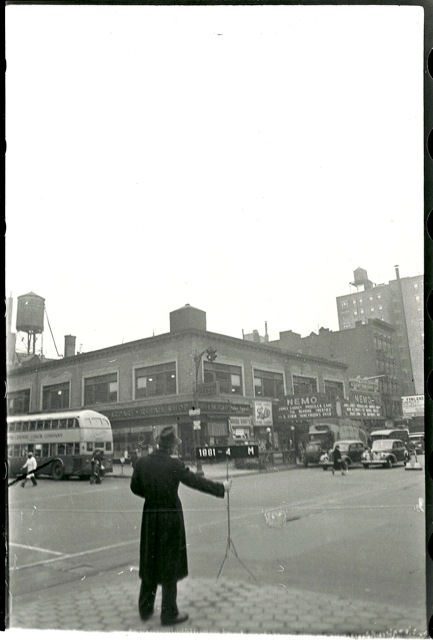
This is the Nemo Theater. It was built in the shell of the Lion Music Hall, a large beer garden restaurant. It was a redesign of a space done by none other than Thomas Lamb. There is the man in the hat again.
The Nemo opened in 1919 and was originally a Fox theatre with a seating capacity of just over 900. On May 2, 1926, the Nemo presented the first public demonstration of Fox's new "Movietone" sound system, though the program consisted only of short films. The Nemo closed in 1963 and was converted into a Daitch Shopwell which subsequently became a D'Agastino. The building came down and by 2003 the new building with a new D'Agastino opened.
The late 19th century apartment building is gone and so soon shall be the one story structure on the corner. Again this is prior to 1933 and there is probably some activity in the void left by the demolished apartment building.
The Midtown Theater opens in 1933. It is designed by the firm Boak & Paris who designed the beautiful 315 Riverside Drive on 104th street. It is not a large house, only 480 seats. It is a first run house.
This is the Midtown Theater of the 1970's. It had been an art house before this.
This is a view of Broadway and 110th street around 1939. There is a downtown 5th Avenue Bus Company double decker heading east. The bus came down Riverside Drive then across 110th street to 5th Avenue. It is now the number 4 bus.
110th Street in the late 19th century was referred to as "Little Coney Island" due to the number of bars and entertainment venues surrounding this intersection. Given it's proximity to what would be the new campus for Columbia University, a new subway that was going to open in the early 20th century sparking development in this neighborhood known as Morningside Heights and as a connector street between Central Park and Riverside Drive and Park, this nice wide street was a likely place for commercial and entertainment development.
This is the Nemo Theater. It was built in the shell of the Lion Music Hall, a large beer garden restaurant. It was a redesign of a space done by none other than Thomas Lamb. There is the man in the hat again.
The Nemo opened in 1919 and was originally a Fox theatre with a seating capacity of just over 900. On May 2, 1926, the Nemo presented the first public demonstration of Fox's new "Movietone" sound system, though the program consisted only of short films. The Nemo closed in 1963 and was converted into a Daitch Shopwell which subsequently became a D'Agastino. The building came down and by 2003 the new building with a new D'Agastino opened.
This is the Carlton Theater. The building was put up in 1912 as the Riverview Theater, the final project of the builder of the Ansonia apartments, W. E. D. Stokes. William Earle Dodge Stokes was born in 1852 into the incredibly wealthy Phelps Dodge family. But in the early 1880's he left the family mining business and began developing real estate on the Upper West Side.
After building several rows of townhouses, Stokes embarked on the development of one of New York's signature landmarks, the Ansonia Hotel, on Broadway from 73rd to 74th Street. He listed himself as "architect in chief" when he filed the plans at the Department of Buildings in 1897, but he was working with the French-born designer Paul Duboy.
Opened in 1903, the $3 million Ansonia had 350 suites with several restaurants, a bank, a barbershop, a ballroom, a swimming pool and full hotel services, along with an imposing Parisian-style facade of turrets and balconies. Part of the wave of theater construction at that time, the Riverview Theater was his final project.
The Theater became The Carlton Ballroom and then a Red Apple Supermarket in 1980. It eventually became a Gristedes then became one of the few one story structures to collapse during demolition ever (someone parked a bulldozer on top of the partially demolished structure). The picture playing is Babes In Arms starring Judy Garland and Mickey Rooney.
This is the Arden Theater on Columbus Avenue and 103rd Street. That is the 9th avenue el overhead with the 104th street station visible on the right and the Ye Old Log Cabin Bar & Grill on the left. Seating just under 600, the theater opened as a second run house in 1934. It was gone by the mid 50's as demolition for the Douglas Houses began.
This is the long lost and long missed Loew's 83rd Street. It is 1939 and the picture playing is The Women. The theater opened on September 26, 1921, with vaudeville and a feature movie combination. Designed by Thomas Lamb, the theater was very similar to the larger Loew's State, which opened on August 9th,1921. The State had a larger and more elaborate lobby due to its prime location on Broadway in the heart of the Times Square area.
This palace was first cut up int a "triplex", then a quad. The seats were never re-angled, left in their original single screen position so you always sat at a slight angle from the screen. Until it was cut up into a quad the entire balcony was the third theater in the triplex era. You had a view of the intact auditorium and it's box seats from the balcony. Just before it was torn down I was fortunate enough to get a tour of the remains on the orchestra section and the stage. Everything in front of the wall they had put into make it a quad was intact, however the boxes had been removed. The orchestra pit had been covered up long ago. The pin rail was intact as was a white grand piano sitting in the middle of the stage. On the stage left wall there were windows looking into a stair case that went up at least 4 floors This was the stairs to the dressing rooms.
This is the organ from Loew's 83rd. I am not sure if this is a Wurlitzer or a Robert Morton. By the way, I should explain who the man in the hat is. These pictures are from a collection of pictures that the City of New York had taken of every building in the city. The City had gotten some WPA money for an art project so out of work photographers were hired to go around and collect the images. the numbers on the tripod refer to block and lot numbers.
After building several rows of townhouses, Stokes embarked on the development of one of New York's signature landmarks, the Ansonia Hotel, on Broadway from 73rd to 74th Street. He listed himself as "architect in chief" when he filed the plans at the Department of Buildings in 1897, but he was working with the French-born designer Paul Duboy.
Opened in 1903, the $3 million Ansonia had 350 suites with several restaurants, a bank, a barbershop, a ballroom, a swimming pool and full hotel services, along with an imposing Parisian-style facade of turrets and balconies. Part of the wave of theater construction at that time, the Riverview Theater was his final project.
The Theater became The Carlton Ballroom and then a Red Apple Supermarket in 1980. It eventually became a Gristedes then became one of the few one story structures to collapse during demolition ever (someone parked a bulldozer on top of the partially demolished structure). The picture playing is Babes In Arms starring Judy Garland and Mickey Rooney.
This is the Arden Theater on Columbus Avenue and 103rd Street. That is the 9th avenue el overhead with the 104th street station visible on the right and the Ye Old Log Cabin Bar & Grill on the left. Seating just under 600, the theater opened as a second run house in 1934. It was gone by the mid 50's as demolition for the Douglas Houses began.
This is the long lost and long missed Loew's 83rd Street. It is 1939 and the picture playing is The Women. The theater opened on September 26, 1921, with vaudeville and a feature movie combination. Designed by Thomas Lamb, the theater was very similar to the larger Loew's State, which opened on August 9th,1921. The State had a larger and more elaborate lobby due to its prime location on Broadway in the heart of the Times Square area.
This palace was first cut up int a "triplex", then a quad. The seats were never re-angled, left in their original single screen position so you always sat at a slight angle from the screen. Until it was cut up into a quad the entire balcony was the third theater in the triplex era. You had a view of the intact auditorium and it's box seats from the balcony. Just before it was torn down I was fortunate enough to get a tour of the remains on the orchestra section and the stage. Everything in front of the wall they had put into make it a quad was intact, however the boxes had been removed. The orchestra pit had been covered up long ago. The pin rail was intact as was a white grand piano sitting in the middle of the stage. On the stage left wall there were windows looking into a stair case that went up at least 4 floors This was the stairs to the dressing rooms.
This is the organ from Loew's 83rd. I am not sure if this is a Wurlitzer or a Robert Morton. By the way, I should explain who the man in the hat is. These pictures are from a collection of pictures that the City of New York had taken of every building in the city. The City had gotten some WPA money for an art project so out of work photographers were hired to go around and collect the images. the numbers on the tripod refer to block and lot numbers.
Monday, August 22, 2011
West 103rd Street July 1, 1888
This is the Downes Boulevard Hotel & Restaurant. The photo was taken form the roof of a building whose original address was 890 Boulevard, a mixed commercial/residential speculatively built structure. The building still stands, although it has been renumbered 2708 Broadway and is home to Petland Discounts. The photo was taken on July 1, 1888 and it was one of at least 17 taken that day by an unknown photographer.
The street in the foreground is 103rd street. The Downes Boulevard Hotel & Restaurant was located on the block of 103rd street between Broadway and Amsterdam Avenue. According to the 1867 map of the area the structure is there with a little lane running diagonally across what would become the block from south west to north east. The lane may also have served as a property line. Contemporary accounts of the hotel and restaurant were not all that favorable. If the hotel was in operation just after the Civil War it served a purpose - a place to stay if travel down the old Bloomingdale Road was difficult due to weather or other circumstances. Kind of a Motel 6 for the last half of the 19th century. The 9th Avenue Elevated did not open until 1879.
I believe that this picture was taken by the same unknown photographer. The view is from the same vantage point as the previous picture and it looks to be not just the same time and season, but the sign for The Downes Boulevard Hotel & Restaurant is visible as well. In addition, back then, photography was such a pain in the but that no one dragged a camera around to take just one picture.
The shack in the middle sits where 884 West End Avenue now stands. The photo, again, appears to be one of the at least 17 taken on July 1, 1888. What crop is being covered in the foreground is a mystery. The house with the conical tower is not on the map of 1867. According to the map of 1867 the land on which this shack sits was owned by Furniss family whose holdings in the neighborhood where reduced throughout the 19th century down to the block between West End Avenue and Riverside from 99th to 100th street. The property line stretched out into the middle of 103rd street between West End and Broadway. The streets were on the maps of 1811 but there was nothing there where the streets eventually would be. On many occasions, property lines in no way adhered to the grid plan. In many cases the streets were laid out, sewer and water lines put in and the road graded and flattened but the surrounding property was left untouched and often turned these newly laid out streets into mud filled gullies.
The house in the center of the photo is on the map of 1867. The land was owned by W.P. Dixon. I do not know if Dixon lived in the house as they owned other land in this area that had large houses on it as well. In addition, he also owned land along 110th street on which he built simple wooden houses for a working class community called Dixonville. The 2 story frame house in the middle with the Adirondack Chairs on the porch is now occupied by 895 West End Avenue. Dixon, Furniss, De Peyster, Rogers, Stryker (sometimes spelled Striker) and Astor are common names of land owners in this area. The stone castle looking building sits approximately where 320 Riverside stand today. The telephone pole and the top of the street light (at the very bottom of the photo) are on Broadway.
Friday, August 12, 2011
96th Street
The little inlet, or bay, is the current site of (probably) the red clay courts in Riverside Park. Once a beautiful pastoral spot, it inspired the poem "Woodsman Spare That Tree". James Stryker is the name of the land owner and that is his house, indicated on the shore of the bay that would eventually bear the name "Striker's Bay". I always say that New Yorkers love to corrupt things; politicians, policemen, spellings and pronunciations are some of things corrupted in this town since it was called Fort Amsterdam. Stryker, or Striker is anither old New York name. The Stryker family got their hands on this land right after the Revolution from what was once a much larger pre- revolution estate owned by a man named Charles Apthorpe. His estate, Elmwood, was a large spread containing a farm, an orchard and a large house that remained standing late 19th century. Unfortunately for Mr. Apthorpe, he was on the wrong side of the Revolution and as punishment he lost a good deal of land. His daughter however, married a patriot who received the southern piece of the estate and built a large mansion. The mansion was torn down in the very early 20th century and replaced with the Apthorpe Apartments on 79th street. Some estate that Elmwood. It was so nice that George Washington used it for a bit as the British chased him up the old Bloomingdale Road.
As for the Stryker family, they did just fine, especially through marriage. One of the large farms of the colonial era in what is now Hell's Kitchen was owned byAndreas Hopper and his descendants. It spanned the area between what is now 48th Street nearly to 59th Street and stretched from the river east to what is now Sixth Avenue. One of the Hopper farmhouses, built in 1752, stood near 53rd Street and 11th Avenue. This was the home of the War of 1812 veteran, Gen. Garrit Hopper Striker, and lasted until 1896, when it was demolished; the site was purchased for the city and landscaped as DeWitt Clinton Park. It was the General's ancestor Garrit Stryker who, after Washington's defeat at the Battle of Long Island and the great fire of 1776, took off from the family home and followed Washington up the Bloomingdale Road and out of the city and eventually distinguished himself at the Battle of Trenton.
No longer pastoral, the end of 96th street became a dock that served, amongst other things, this large coal facility. Used for hot water and heating in apartment buildings large and small, coal was the thing until we discovered how dirty it is. In addition to this facility there was a coal yard on 96th and Amsterdam Avenue. Prior to consolidating his passenger rail service out of Grand Central Station in 1871, Commodore Vanderbilt ran his Hudson River Rail Road as a freight and passenger line. There was once a station here at 96th Street.
The U.S.S. Illinois and the New York Central tracks.
No security? The sewage treatment plant under Riverbank State Park at least has a guard booth. Will it was a different world. As you probably have noticed over the years, there are no longer any docking facilities at the foot of 96th street and the Hudson River. Robert Moses took all of this away, he cut off the river from the citizens of the west side by improving it with one of his beloved highways. He did, however create more Riverside Park for the citizens of New York City. Once Mr. Moses received the financing for this project from the W.P.A, he became a hero in the eyes of a large number of unemployed construction workers as this was a large scale, big budget project. Some say this park is emblematic of the racism inherit with Robert Moses - the park basically ends at 125th street. While I do not argue that Mr. Moses was not a racist (and potentially more damaging than any one group had ever been in this town) the natural landscape, the plateau that is Morningside Heights, drops off there, just north of Grants Tomb. In addition, the street we call 125th street by the Hudson river was already developed industrially by the mid 19th century (the Tiemann Paint factory for example) with the growth of Manhattanville. Natural topography and this community separated the park south of 125th and the park north of 135th. Just to be fair.
This is Cleopatra's Needle, a gift from the people of Egypt to the people of New York. Due to the docking facilities here at 96th street, the location being actually the closest dock to where the needle would go, when it arrived in New York harbor from Egypt, the needle was loaded onto a barge then floated up the Hudson to 96th street. Here it is, being hauled east across 96th street on a specially constructed railroad trestle towards Central Park. The smoke stack from the engine pushing the needle is visible at the bottom of the needle.
This is looking north from the foot of 96th street. Although no passenger service ran along this line by the time this picture was taken in 1934, that us a passenger car heading north on the left.
This is the same spot, just looking south. Watch out kids as you cross the tracks. The third rails indicate that there are no more steam trains coming onto this island anymore. The type of third rail seen here is still used today by the Metro North rail road. These tracks belonged to the New York Central as did what is now most of Metro North.
As for the Stryker family, they did just fine, especially through marriage. One of the large farms of the colonial era in what is now Hell's Kitchen was owned byAndreas Hopper and his descendants. It spanned the area between what is now 48th Street nearly to 59th Street and stretched from the river east to what is now Sixth Avenue. One of the Hopper farmhouses, built in 1752, stood near 53rd Street and 11th Avenue. This was the home of the War of 1812 veteran, Gen. Garrit Hopper Striker, and lasted until 1896, when it was demolished; the site was purchased for the city and landscaped as DeWitt Clinton Park. It was the General's ancestor Garrit Stryker who, after Washington's defeat at the Battle of Long Island and the great fire of 1776, took off from the family home and followed Washington up the Bloomingdale Road and out of the city and eventually distinguished himself at the Battle of Trenton.
No longer pastoral, the end of 96th street became a dock that served, amongst other things, this large coal facility. Used for hot water and heating in apartment buildings large and small, coal was the thing until we discovered how dirty it is. In addition to this facility there was a coal yard on 96th and Amsterdam Avenue. Prior to consolidating his passenger rail service out of Grand Central Station in 1871, Commodore Vanderbilt ran his Hudson River Rail Road as a freight and passenger line. There was once a station here at 96th Street.
The U.S.S. Illinois and the New York Central tracks.
No security? The sewage treatment plant under Riverbank State Park at least has a guard booth. Will it was a different world. As you probably have noticed over the years, there are no longer any docking facilities at the foot of 96th street and the Hudson River. Robert Moses took all of this away, he cut off the river from the citizens of the west side by improving it with one of his beloved highways. He did, however create more Riverside Park for the citizens of New York City. Once Mr. Moses received the financing for this project from the W.P.A, he became a hero in the eyes of a large number of unemployed construction workers as this was a large scale, big budget project. Some say this park is emblematic of the racism inherit with Robert Moses - the park basically ends at 125th street. While I do not argue that Mr. Moses was not a racist (and potentially more damaging than any one group had ever been in this town) the natural landscape, the plateau that is Morningside Heights, drops off there, just north of Grants Tomb. In addition, the street we call 125th street by the Hudson river was already developed industrially by the mid 19th century (the Tiemann Paint factory for example) with the growth of Manhattanville. Natural topography and this community separated the park south of 125th and the park north of 135th. Just to be fair.
This is Cleopatra's Needle, a gift from the people of Egypt to the people of New York. Due to the docking facilities here at 96th street, the location being actually the closest dock to where the needle would go, when it arrived in New York harbor from Egypt, the needle was loaded onto a barge then floated up the Hudson to 96th street. Here it is, being hauled east across 96th street on a specially constructed railroad trestle towards Central Park. The smoke stack from the engine pushing the needle is visible at the bottom of the needle.
This is looking north from the foot of 96th street. Although no passenger service ran along this line by the time this picture was taken in 1934, that us a passenger car heading north on the left.
This is the same spot, just looking south. Watch out kids as you cross the tracks. The third rails indicate that there are no more steam trains coming onto this island anymore. The type of third rail seen here is still used today by the Metro North rail road. These tracks belonged to the New York Central as did what is now most of Metro North.
Tuesday, August 9, 2011
Riverside Drive at 103rd Street
This is looking north from the top of the stairs at 103rd street just after the completion of the retaining wall, around 1880.
This is looking south from the same vantage point.
This is looking south as well. The park as we now it today did not exist until the designs of the West Side Improvement were executed. This project, spearheaded by Robert Moses, the notorious power broker, covered over the New York Central tracks and created the West side Highway. This also created all the ball fields between the highway and the western wall of the "tunnel" covering the tracks. A great deal of the landfill came from the independent subway construction (the dirt had to go somewhere), other construction projects of the day as well as municipal refuse.
The structures on the river are at 96th street. There was a large coal dock in addition to the U.S.S. Illinois, a battleship launched in 1898, served in World War I, refitted the Naval Reserve Midshipmen Training School after being excluded from service. It was moored at 96th street until the improvements were in place. It was finally scrapped in 1956.
Although the park was substantially altered during the 1930's, there are some recognizable features. I believe that the path that veers off to the left toward the river is now the path that leads down to the promenade and the dog run at 105th. The path that heads north is still there and ends north of 116th street.
The path that is here now winds down to the promenade ending next to the dog run. Now there is park and highway where those boats are moored.
This is again Riverside Park at 103rd street looking north from the top of the stairs next to the 1879 stone wall. This time it looks like winter and it appears to be the very early 1920's.
This is part of the same series. The path next to the train tracks was probably located just a little east of the promenade that is now over the tracks. The park had a great deal of re-landscaping during the Westside Improvement Project and the tracks were covered, not moved. The field to the west of the tracks is landfill that will very soon be the West Side Highway, the ball fields and the swing rings at Hudson beach.
This is looking south from the same vantage point.
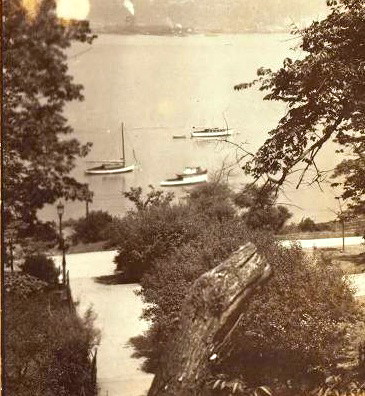
This is looking south as well. The park as we now it today did not exist until the designs of the West Side Improvement were executed. This project, spearheaded by Robert Moses, the notorious power broker, covered over the New York Central tracks and created the West side Highway. This also created all the ball fields between the highway and the western wall of the "tunnel" covering the tracks. A great deal of the landfill came from the independent subway construction (the dirt had to go somewhere), other construction projects of the day as well as municipal refuse.
The structures on the river are at 96th street. There was a large coal dock in addition to the U.S.S. Illinois, a battleship launched in 1898, served in World War I, refitted the Naval Reserve Midshipmen Training School after being excluded from service. It was moored at 96th street until the improvements were in place. It was finally scrapped in 1956.
Although the park was substantially altered during the 1930's, there are some recognizable features. I believe that the path that veers off to the left toward the river is now the path that leads down to the promenade and the dog run at 105th. The path that heads north is still there and ends north of 116th street.
The path that is here now winds down to the promenade ending next to the dog run. Now there is park and highway where those boats are moored.
This is again Riverside Park at 103rd street looking north from the top of the stairs next to the 1879 stone wall. This time it looks like winter and it appears to be the very early 1920's.
This is part of the same series. The path next to the train tracks was probably located just a little east of the promenade that is now over the tracks. The park had a great deal of re-landscaping during the Westside Improvement Project and the tracks were covered, not moved. The field to the west of the tracks is landfill that will very soon be the West Side Highway, the ball fields and the swing rings at Hudson beach.
Subscribe to:
Posts (Atom)